Krysmallow's Species Info
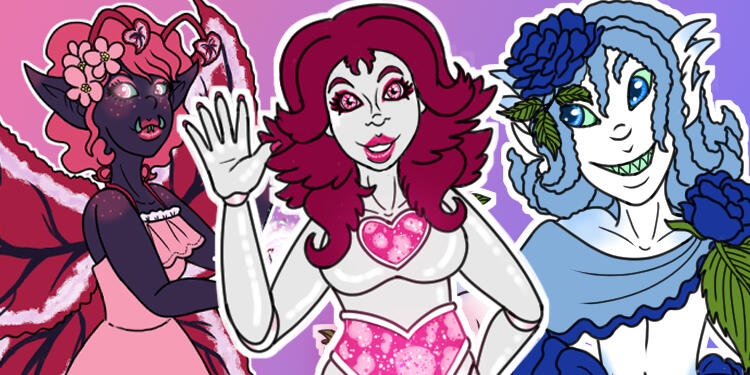
On this carrd you will be able to find info in regards to the closed/unique species created by the artist, Krysmallow. At this time the species are Florallings (with multiple subspecies) and Lavalams, but more may be added in the future!Please note that both species are closed and you cannot make one unless you get a MYO (Make Your Own) slot, which you can find out more info on that page on how to do so.Use the buttons below to navigate the info on this site, and feel free to use the socialm edia links above if you're interested in following any of Krysmallow's socials!
Florallings
Additional Info | Florfauna | Faeflora | Merflora
Florallings are humanoid creatures that were once flowers that after hearing their more fervent of wishes and dreams the earth goddess chose to grant their wishes and give them their new forms to help in doing so. They come in a variety of shapes and sizes as well as a few different subspecies variants.The following are visual guides for the species. If the images are not clear enough you can click on them to linksfor larger views.

Additional Info
Gender: When a floralling is born they can opt to present themselves as any gender as they choose, and as they grow and evolve they can shift their forms at will just like any part of their body. As such they are in essence a 100% genderfluid race, but some do choose to go by one certain gender so it is always best to ask their preferences when getting to know one.
Causing Them Pain: Pulling their flowers off can cause quite a bit of discomfort to the floralling but would not kill them even if you ripped them all off since they can just regrow them anew. The only exception to this is when a floralling removes a flower themselves. Cutting them or even removing limbs also will hurt them, but not so much as to remotely kill them, as they can grow back limbs and mend cuts back together fairly quickly, specially if they root themselves to the ground and take in nutrients while doing so.
Lifespans: A florallings lifespan correlates to the lifespan of the flower they are born from. For every season a flower can survive, the floraling counterpart will live an average of 25 to 30 years. They grow from baby to adult stage very quickly, often times in the span of a year or less, so that they can get the most out of their commonly short lifespans. As they get near their end their foliage will start to have a shriveled appearance and their colors will be very dulled.
Death: While they are able to regrow and heal from most wounds as long as a majority of their body is still left standing, there are two things that are utterly lethal to a floralling. The first is fire, which when damaged by it they will never be able to health the damage, and if over 50% of their body is burnt they will eventually wilt and die, unable to sufficiently take in the nutrients they need. The other is human medicines, which is very poisonous to them and within 24 hours will often kill a floralling without any hope of survival depending on what the medicine is and just how strong a dosage. The only chance of possibly surviving this is immediately rooting themselves to the ground and hoping that they pull in enough nutrients to replace the harmful chemicals in their body before it does irreparable damage.
Breeding: Due to not having internal sexual organs like other humanoids Florallings are not able to breed with non-plants. They can only breed with other floralings and plant creatures that are capable of pollinating. The process involves the two growing a large plant-pod from a seed taken from the floralling and then pollinating it with pollen from their flowers, which will eventually grow into their future child. If they breed this way with a non-floralling, the creature that is born tends to be much sturdier than it's floraling counterpart and have a lifespan and traits more like their other parent.
Feeding Habits: Florallings do not need to eat food (although some may opt to do so anyway for any number of reasons), but what they do need to survive and keep the energy to go by day to day, is to make sure to drink at least one full glass of water every day, and every 48 hours they need to completely root themselves to the ground and take in at least 5 hours of direct sunlight. If they neglect to do this their foliage will start to wilt and over time completely dry out, possibly leading to death if they go more then a week in this state.
Fun Fact: A group of florallings is called a bouquet.
Subspecies
The following are the different subspecies that can be found amongst the Florallings. Again, click on images if larger view is needed.
Florfauna
An animal variant born of a floralling themselves to serve as their companions/pets.

They are born from the Floralling (or Faeflora, or Merflora) they are a pet for, which means they have the same flowers as their Floralling creator.
Their creation involves a similar process as when Florallings breed, where a small pod is created and the essence of the Floralling is put into it. In this case though only one Floralling is needed and the pod is about 1/3rd the size of a normal Floralling pod.
They can be any type of 'real' animal. Meaning magical beasts and such are not possible. There may be special events and such in the forward for exceptions to this.
Their skin/fur/body are typically the green of their leaves, or something similar. The exception to this is any flowers that typically don't have green leaves (such as the ghost flower cat).
Eyes, teeth, and flower colors are all the same as their creator.
Features such as tails, ears, and wings are common places to be changed into floral elements. For animals that don't really have any of those the placement can be a little more random and case by case.
They do not have any sexual anatomy and cannot breed. The only way to get another Florfauna is for the original Floralling to create another one.
Their lifespan and weaknesses are the same as the Floralling that created them, since they're essentially sharing the same soul as their creator.
Faeflora
A more magical variant often found in fantasy worlds with a fairy like appearance.

Bug/fairy like wings that are based/look like the leaves of the flower they are a faeflora of. Because of this, it's usually more common that broad-leafed or fancy looking leaved flowers are faeflora, but it's not unheard of for more simple leaved flowers to be them as well. In the end it's all about how strong their wish is, after all!
Small bug-like antenae on their heads, that end in small versions of their leaves and the stems are the color of their leaves.
Glowing pupils, ranging from very faint to very bright, depending on just how strong the magical energy is in the faeflora.
Their legs are almost always footless and tend to taper into thin points much more then a normal florallings does, giving them an almost bug-like appearance.
and the following is some additional information!
The reason a floralling becomes a faeflora instead of a normal floralling is due to the strength of their wishes, which are particularly and overbearingly strong and usually of an altruistic nature (although on rare occasion they can be for more selfish/cruel/mischievous reasons that are strong enough to be considered.) Typically their wishes involve helping large numbers of people or generally doing something for more then just themselves.
It's far more common for them to be born into worlds that are strong with magic and/or fantasy creatures, BUT that doesn't mean they can't be found in more modern settings as well like regular florallings, it's just not as common.
They are innately more magically inclined, able to use many forms of magic (except fire magic, not a single one can learn fire magic, as the second they'd try and use it they'd damage themselves greatly due to it being the florallings biggest weakness and all.) Most tend to excel at healing or earth/plant based magic but some might find themselves doing water, air, or other forms of magic as well. The one's that are born of darker intents can also be found to learn more dark arts such as shadow magic or necromancy.
When it comes to a faeflora creating a florfauna companion, they can be of a more magical variety of animal (I.E. you could see florfauna of mythical creatures and such that belong to faeflora, whereas normal floralings can only make florfauna based on real world creatures.)
Merflora
An aquatic variant with a mer-like tail who live in and around areas with water.

The fins of their tail are shaped like the leaves of their flower. It can be multiple leaves or one, like the examples shown in the visual guide.
The main part of the tail is made out of plant matter. Tails can look different between Merflora in color and texture but they are always made up of some sort of plant material.
They have gills on their neck, webbed fingers, and small fins on their arms. Their shape can resemble the leaf’s shape but it doesn’t have to. The shape combination of fin, gills, and arm fins can be different.
Merflora are born when a flower has a deep connection to water or things that are related to areas near or in water. This could be for a number of reasons. Creativity is encouraged!
A Merflora’s flower must be a type that grows in or around water. Remember: Not all aquatic flowers are Merflora but all Merflora are aquatic flowers.
An existing Floralling or Faeflora cannot become a Merflora, or vice versa. Merflora are “born” as Merflora.
Merflora come in different shapes and sizes but, like Florallings, are typically as tall as humans.
Like Faeflora, Merflora are more often found in fantasy or magical settings but can be found in any universe with Florallings. It is more rare to find them in a non-magical world.
Merflora don’t have any magical abilities. They can regenerate parts of their bodies like Florallings can but that’s not really considered magic. They are very sensitive to and in touch with water and aquatic life, however. It is possible for them to develop a mutual understanding with aquatic life.
They can create Florfauna companions just like Florallings. The Florfauna must be an aquatic or semi-aquatic animal that can live in the water most of the time. The most common type of Florfauna for a Merflora to have is some type of fish.
Being out of the water can be extremely deadly for Merflora. After a few hours the Merflora must find enough water to dip their tail in in order to feel comfortable. After 12 hours of no water the Merflora begins to notice signs of dehydration and can feel ill. They must find enough water to dip their lower halves in in order to feel well again. If the Merflora is still out of the water after 24 straight hours they could shrivel up and die. After the 24 hour mark the Merflora must find enough water to dip their entire body into immediately. It is important to stay completely in the water until they feel well again, which could take as long as a few hours to a few days. If water is found immediately at the point of extreme dehydration it is possible for the Merflora to survive, but irreversible damage has been done to the Merflora’s body.
Lavalams
A species of robotic dolls with light fixtures of some sort in tanks on their body (originally and most commonly lavalamp fluid lighting). Created by a company called Lavali Co, they are typically purchased for business purposes or for companionship reasons for private individuals. They come in all sorts of shapes, sizes, and styles.Below is more information, including visual guides. If any are hard to read you can click on them for larger versions!


Additional Information
While it's not necessary, Lavalams often are dressed in 70's fashion attire, as that is the theme of the company that produces them (and the species in general) but if you want one that is more modern or other era based that's completely fine!
As Lavalams are robots they tend to interface very well with all things technological and are very intelligent when it comes to that sort of area.
Due to their main purpose being for entertainment reasons, they are equipped to be very effective as a media server, able to play music or play holographic projections from their pupils (not available with lavalamp pupils). They can, of course, turn this feature off at will if they choose.
Lavalams do not do well submerged in water, due to it potentially damaging their inner workings, specially seawater as the salt content could really damage them if exposed too long. When it comes to hygiene damp cloths and gentle washing with immediate drying with a soft fabric that isn't prone to getting staticy is best.
While they do not have a soul in the 'normal' sense of the word, they have been equipped with a fully functioning mental core that gives them a unique personality and the ability to develop as a person all their own, which means that yes, they can go bad if influenced in the wrong way.
Technically Lavalams do not have a real gender, but they do typically physically present as male or female, but it's not uncommon for them to decide to use other pronouns and gender options if they so feel it.
Unless they have synthetic skin covering it, the joints for the lavalams are at their shoulders, elbows, wrist, chest (underneath the breast area), hips, knees, and ankles.
Tanks must be encompassed completely in only one part of the body, as in they cannot traverse over where a joint would be as it would make it very hard for the lavalam to actually move that part of their body at that point! That said, a whole individual body part CAN be a tank in and of itself, just know that the edges that would connect to the rest of the body must be bordered by the metal framing and not part of the tank. (Example: they can have a forearm that is completely a tank, but the part that connects to the wrist and elbow joint balls would be the metal framing.)
Additional Traits
The Following are additional traits that can be purchased as add-ons for a Lavalam. The shop traits can be bought year round whereas the season traits can be as well but out of season traits will cost more then if you buy them in season.


MYO (Make Your Own)
Now that you've learned about the species housed on this carrd, do you find yourself wanting to make one yourself? The main way to do so is to purchasea MYO (Make Your Own) slot, which the pricing for will be included below. Past that there may be occasional giveaways of slots on Krysmallow's discord server if you are a member, or more public MYO event on a rare occaasion.If you wish to purchase a slot, please contact Krysmallow on disccord and payment options can be discussed from there.
Floralling MYO Prices
Floralling Slot - $20
Faeflora Subspecies slot - $30
Merflora Subspecies slot - $30
Florfauna slot - $10 *
* Florfauna cannot be bought alone, they must be combined with a Floralling (or Faeflora or Merflora) of the same type as they are created from the Florallings themselves. So either it is $10 to buy one for an already existing Floralling you own, or it's an added $10 to the cost of the Floralling MYO slot you are getting to pair them with.
Lavalam MYO Prices
Common Slot - Unlocks unlimited common traits - $20
Uncommon Slot - Unlocks unlimited common and uncommon traits - $25
Rare Slot - Unlocks unlimited common, uncommon, and rare traits - $30
If you know you'll only want to use one or two uncommon or rare traits and don't want to pay the full price for a uncommon/rare MYO slot, you can instead buy a single uncommon/rare trait to add to a common slot for the following prices:
Single Uncommon Trait Add-on - $2 per trait
Single Rare Trait Add-on - $5 per trait
You can also use the above trait add-ons to add a uncommon or rare trait to a previously made Lavalam.
Additional Traits (Shop and Seasonal)
Shop Traits - $5 per trait
Seasonal Traits - $5 per trait when in season, $25 if out of season